PulzarFM
PulzarFM public profileStation history, frequencies and the December 2011 shutdown.
At PulzarFM I was Sales Manager and also took over the Friday and Saturday late night dance music shows. There was very little client history, almost no sales infrastructure and no real budget, so the job was a mixture of building revenue from scratch, bringing inexperienced people along for the ride, and then spending the weekends pushing the station much harder on air.

External references are provided for chronology and context. They do not imply endorsement, employment verification or a commercial relationship beyond what the chapter itself describes.
Working as Sales Manager at PulzarFM was not a conventional sales-management job. The station had very little client history, no established sales team and practically no budget. Most of the time it was me, plus whoever had decided they wanted to give radio sales a try that week. Some had enthusiasm. Almost none had experience.
At the same time I was running the Friday and Saturday late-night shows, organising live DJs, promoting the nights and bringing in my own sponsors. The weeks were busy.
One day station founder Andy Poulsen called me into his office and pointed to a large pile of mail on his desk.
“You know what that is, David?”
“No.”
“It’s bills.”
“Who’s Bill?”
I have always had a tendency to make jokes at inappropriate moments.
Andy explained that if the station could not find about $3,000 that week, things were going to become very uncomfortable. I pointed out the obvious problem: it is not particularly easy to telephone a stranger and ask them for several thousand dollars when you do not yet have an established commercial relationship with them.
There were a couple of existing station relationships, but Andy looked after those himself. Then he mentioned Carolyn, who owned venues on Christchurch’s old Strip, including Ferment and Liquidity. I remember the meeting as being at Ferment. She already had a small month-to-month arrangement with PulzarFM, around $500 a month, and it was due for renewal.
“OK,” I said. “I’ll call her.”
Carolyn agreed to see me after lunch service that day. During the call she added one slightly unexpected condition: “You guys can’t have a tab at the bar. I gave MediaWorks a tab and they completely ruined my bar.”
The thought of asking for a bar tab had not even crossed my mind.
I grabbed Miles, one of the aspiring sales guys who had been tagging along with me, and we headed down to The Strip.
When we arrived, the restaurant and bar were mostly empty after lunch service. I told the bar staff we were there from PulzarFM to meet Carolyn. They called her upstairs and told us she would be down in about ten minutes.
That made her roughly five minutes late.
I looked at Miles.
“You want a beer, buddy?”
He looked at me with the uncertain expression of someone who had no idea what lesson he was currently being taught, but nodded.
“Two lagers, thanks.”
The bartender poured them, placed them on the bar and waited for payment.
“They go on Carolyn’s tab.”
She paused. I said it with sufficient confidence that challenging me clearly seemed riskier than entering two drinks into the till, so that is exactly what she did.
At almost that exact moment Carolyn arrived.
I opened with: “You’re late, so I got Miles and me a drink on your tab due to the fact you specifically told me we couldn’t have one.”
She cracked up laughing, called me cheeky and led us outside to a table. The bartender looked visibly relieved.
I then put a $5,000-per-month, three-month advertising proposal in front of Carolyn and told her I would need the first month paid up front, by cheque, there and then.
She signed the very uncomplicated contract I had put together before leaving the station and wrote the cheque.
$5,000.
Miles was astounded. I was reasonably impressed myself.
I walked back into Andy’s office and placed the cheque on his desk, right beside the pile of bills.
He picked it up and his eyes lit up.
“How’d you manage THAT?”
“You own a radio station, Andy. How do you not manage that?”
Then I left for the day.
The lesson was not that every sales meeting should begin by deliberately violating the client’s bar-tab policy. It was that sales is often decided before the formal pitch begins. Carolyn already knew PulzarFM. The challenge was changing the energy of the relationship, establishing confidence quickly and then being prepared to ask for a number dramatically larger than the one everyone had become accustomed to.
Although I loved selected hard drum & bass and later dubstep, I was primarily a harder-edge electro DJ at the time. Friday became harder electro and harder house from about 10pm until dawn. Saturday was deliberately different: harder dubstep and drum & bass, pushed as far as I could find it.
Across both nights I wanted weight, darkness, clever engineering and a sound that did not feel interchangeable with daytime programming.
One of the reasons I invited DJs to bring their friends into the studio was simple: energy. If the DJ was genuinely having a good night, the performance lifted, and that energy went straight out over the radio. So Friday and Saturday nights often became small parties in the studio while we broadcast live.
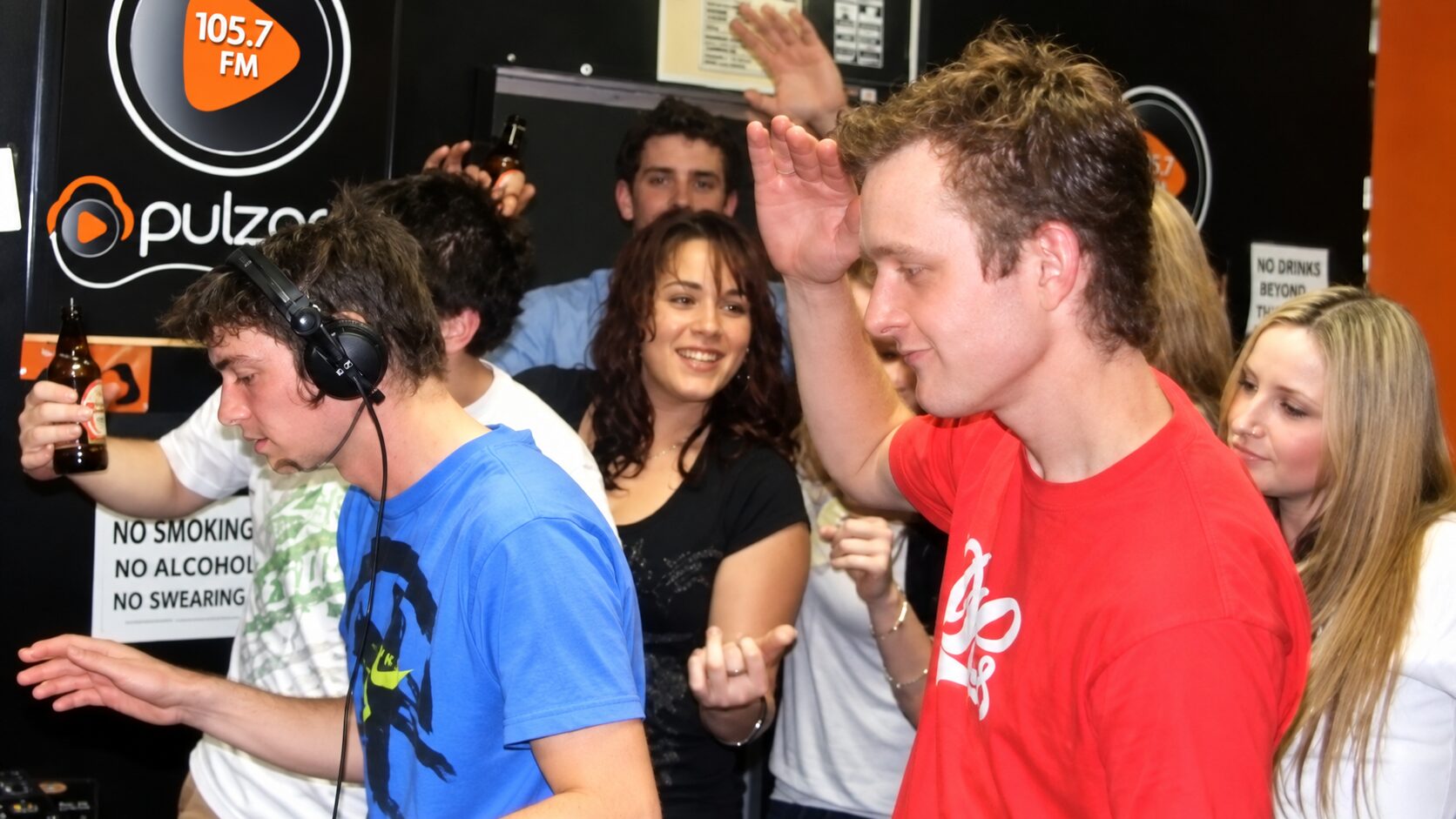
We drank. People smoked. The window stayed open. My theory was that because it was Friday and Saturday night, most of the evidence would have disappeared by the time the weekday shows returned on Monday.
Andy had a different view.
“David, you cannot drink and smoke in the studio.”
“Yeah. Sorry about that.”
I took the lecture, and then usually did it again the following weekend. I knew the party atmosphere was half the reason the shows felt alive, so I was happy to wear the Monday reprimand on behalf of everyone who came in and helped make them.
Eventually I decided to get ahead of it. One Monday morning, before Andy arrived, I printed several signs and stuck them around the studio:
NO SMOKING. NO ALCOHOL. NO SWEARING.
Andy came in, saw them, and had to laugh. As I remember it, the Monday lectures stopped after that.
Which is why the sign in the photograph still makes me laugh: it is sitting there in the background while the studio is very obviously doing what the sign says not to do.
Guest DJs could come in and play live, including people who sat outside the established networks. Christchurch already had a long-running alternative institution in RDU ↗, while Galaxy Records ↗ was one of the city’s key music-scene hubs.
I was much less interested in protecting an existing gate than in finding out what happened when you threw it open.
The response was immediate. In my recollection, the Friday and Saturday late shows became the strongest shows on the station by a wide margin. They created noise in the Christchurch dance scene precisely because the sound and access were different.
Andy and I argued about the direction. He pushed back on the music, the harder tone and things I said on air. At one point he told me: “You know we have a predominantly female audience, right?”
I told him I thought the opposite was true: the audience was predominantly young male. A few days later he came back and told me he had discovered I was right.
The surviving public profile of PulzarFM later described its target audience as ages 16–35 with a 75/25 male/female split. That matches the audience profile I had argued for inside the station.
The important part was not simply that I preferred harder music. It was that I had a read on the audience that conflicted with the station’s internal assumption, and I was willing to push the programming towards what I thought the real audience wanted.
That same instinct shows up repeatedly in my career: question the accepted model, watch the response, then push harder when the evidence says the old assumption is wrong.